
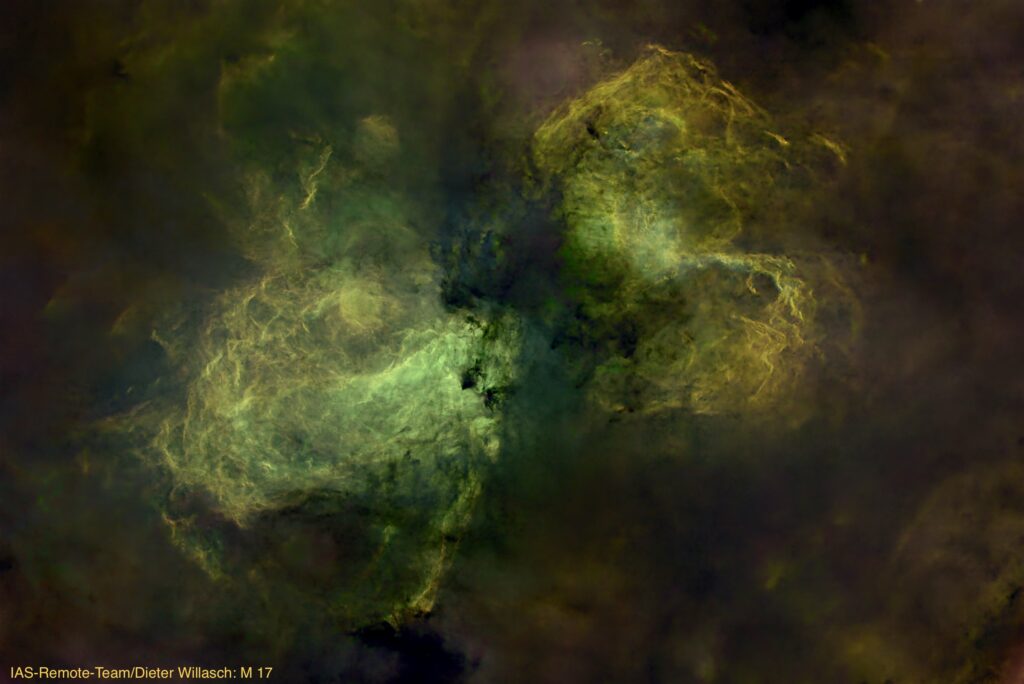
Swan Nebula

Swan Nebula: When you look at the brighter parts of this emission nebula wih a moderate telescope it looks somewhat like a Swan or Omega depending on your fantasy. Exactly these parts are also a gigantic star-burst area, which means that extremely bright young stars are illuminating the hydrogen gas, some of them still enshrouded in the dust and gas cloud, which was their stellar nursary. This deep image also shows an intricate network of fine shock fronts creating a dramatic sky view.
The frames were captured using narrow band filters for hydrogen, oxygen and sulfur and than combined according to the Hubble scheme. Stars were not included to give an undisguised view on the intricate structures of this remarkable skyscape.
Object |
Swan Nebula |
|---|---|
Catagory |
Emission Line Images |
Designation |
M 017 |
Constellation |
Sagittarius |
Optics |
IAS 10" Newton f/4.5 |
Mount |
10Micron GM3000 HPS |
Camera |
QHY268M |
Exposure |
13x1mR, 15x1mG, 14x1mB, 13x5m H-alpha, 12x5m OIII, SII each. Croma Filter. N.I.N.A for capture control and Sequencing |
|---|---|
Calibration |
Dark + Flat Frame |
Guiding |
PHD2 as Guiding Software |
Processing |
PixInsight, Photoshop. Color Code R:SII, G:Ha,B:OIII |
Location-Date |
Ort: IAS - Internationale Amateuersternwarte e.V. - Hakos Observatory, Namibia. April 2023 |
Remark |
Image acquisition: IAS Remote Team 'Lukas'. Image proccessing: Dieter Willasch |