

About me
At that time I had just graduated in Physics from the Technical University in Berlin and started to work in an industrial research lab to make another dream come true: To look at the very small, i.e. molecules and atoms by means of electron beams, in short electron microscopy.
For the next thirty years I was then engaged in a very earthbound adventure: Managing businesses in different environments and places, dimming my childhood dreams.
After retiring I was free and had finally the time to engage in amateur astronomy, a means to discover the cosmos without travelling there. My early background in Physics helped to overcome the first theoretical and practical hurdles when I started off with a Celestron Nexstar 5 Schmidt-Cassegrain telescope and a set of 16x70 Fujinon binoculars. In the meantime more instrumentation has been added. Since we decided to live 6 months each year in Europe and 6 months in South Africa at the Cape I had no limitation in latitude to view astronomical objects.
After several years of sky watching and visual observation I finally decided to extend pure observation by entering the world of digital astro-photography with a Nikon Coolpix camera and then with a Canon EOS 20D DSLR. Also my camera park has grown in the meantime, since the appetite comes often with the eating.
During this time I got caught by the phantastic possibilty of observing through the camera the overwhelming beauty of extended objects like nebulae, star clusters and galaxies in color. The wonderful astro-photographs of Rob Gendler, Steve Cannistra and Stefan Seip, to name only a few, triggered me to also try to image the aesthetics of these deep sky objects and plug them from the night sky onto computer displays. Asking me why I do this, although all these objects have been photographed in high quality before, is like asking a mountaineer why he is climbing a high mountain though others have been up there before.
I am still learning about the challenging technology and art of astrophotography, but every time I see a colored image coming up after digitally developing a series of frames I feel all the excitement and anxiousness of discovery and then deep content of success.
I do not want to forget to thank Rudolf Idler and Peter Schuster from Fernrohrland in Fellbach for their expert advice and their patience in providing to a novice the tools for his adventure.
Equipment
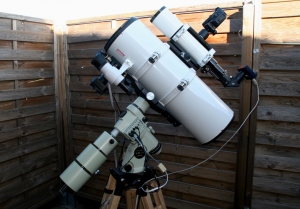
This was until recently the equipment when I was in Germany:
It is an 8" Vixen R200SS f/4 Photo-Newton with Robofocus on a Feathertouch focusser and Tele Vue Paracorr Coma Corrector. Piggy-back is a TMB 80 f/6 APO refractor. Both instruments have been sold in the meantime. As imaging cameras I am using the SBIG STL-11000M and a modified EOS 5D MkII with photo lenses, for additional guiding puposes the StarlightExpress Lodestar and a small refractor.
The mount is a portable Takahashi EM-11 which is connected with an iPad and SkySafari Pro for GOTO performance resting on a Berlebach tripod.
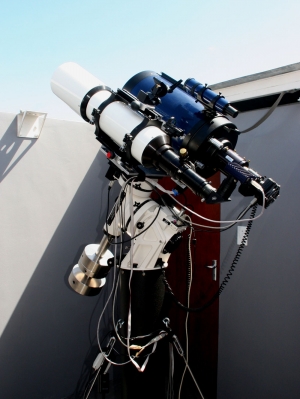
My present equipment in the Helderberg Observatory is an Astro-Physics 900GTO mount, onto which several telescopes and cameras can be mounted. An assembly would be i.e. a Meade LX 200 10" f/10 Schmidt-Cassegrain reflector and a TMB 130 f/6 refractor with Robofocus (as shown in the picture). Both telescopes can be used vice-versa as imaging or guiding scopes. Frequently either the TMB 130 or the LX 200 are exchanged against a Takahashi FSQ 106ED refractor which I bought in December 2009 for larger-angle imaging.
A modified Canon EOS 5D MkII is also sometimes mounted piggy-back on one of the telescopes. Since 2019 I am using an ASI 1600MM Pro CMOS Camera and an ASI 294 MC Pro Color Camera, which can be attached to all telescopes. For autoguiding a StarlightExpress Lodestar CCD camera and an ASI 120 MM Mini camera are quite well suited. For the use of various filters as well as imaging and processing software see the data at the images.
Since January 2009 I own an SBIG STL-11000M large format CCD camera with internal guide camera and filter wheel. This camera is mainly used with the FSQ 106ED. My good friend Kurt Schneider designed and manufactured a perfect OAG for this combination. Therefore the internal guide camera is not needed any longer, which is quite advantageous for narrow band imaging. For wide-angle imaging I am using the STL with photo lenses e.g. of 50mm, 135mm and 200mm focal length. The camera is then mounted into a custom made adapter, so it can be rotated. In addition I am using a Robofocus for remote focussing via an adjustable strap around the focus ring of the lenses.
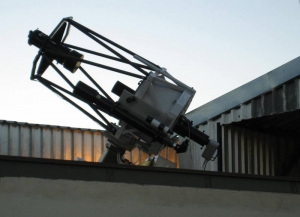
Since 2009 I am a member of the IAS with its astronomical site at Hakos Farm in Namibia. This gives me the opportunity to use several larger telescopes there. My favourite is an 20" Keller Cassegrain (see image) with imaging possibilities in the primary and secondary focus.
Locations
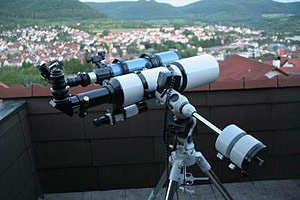
Eningen near Stuttgart, Germany
This is where I take most of my pictures when I am in Europe. It is from my little roof terrace above Eningen. Usually there is quite some ambient light i.e. sky glow from the neighbouring cities. Thanks to the city council of Eningen street lights are shut off on weekday nights. What a wonderful idea!
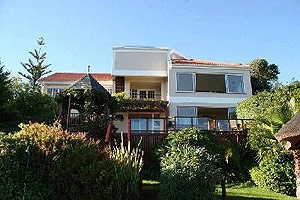
Helderberg Observatory Somerset West near Cape Town, South Africa
On September 13, 2006 I celebrated "First Light" of my private observatory, which I had built into the roof level of our house. It is a very solid brick design with a sliding metal roof. The name is after the spectacular Helderberg mountain, on which extended slope the house stands, in which we live several months per year. In the Cape climate there are many good nights for star viewing and astro photography although the increasingly intensive ambient lights make LPS filters necessary.
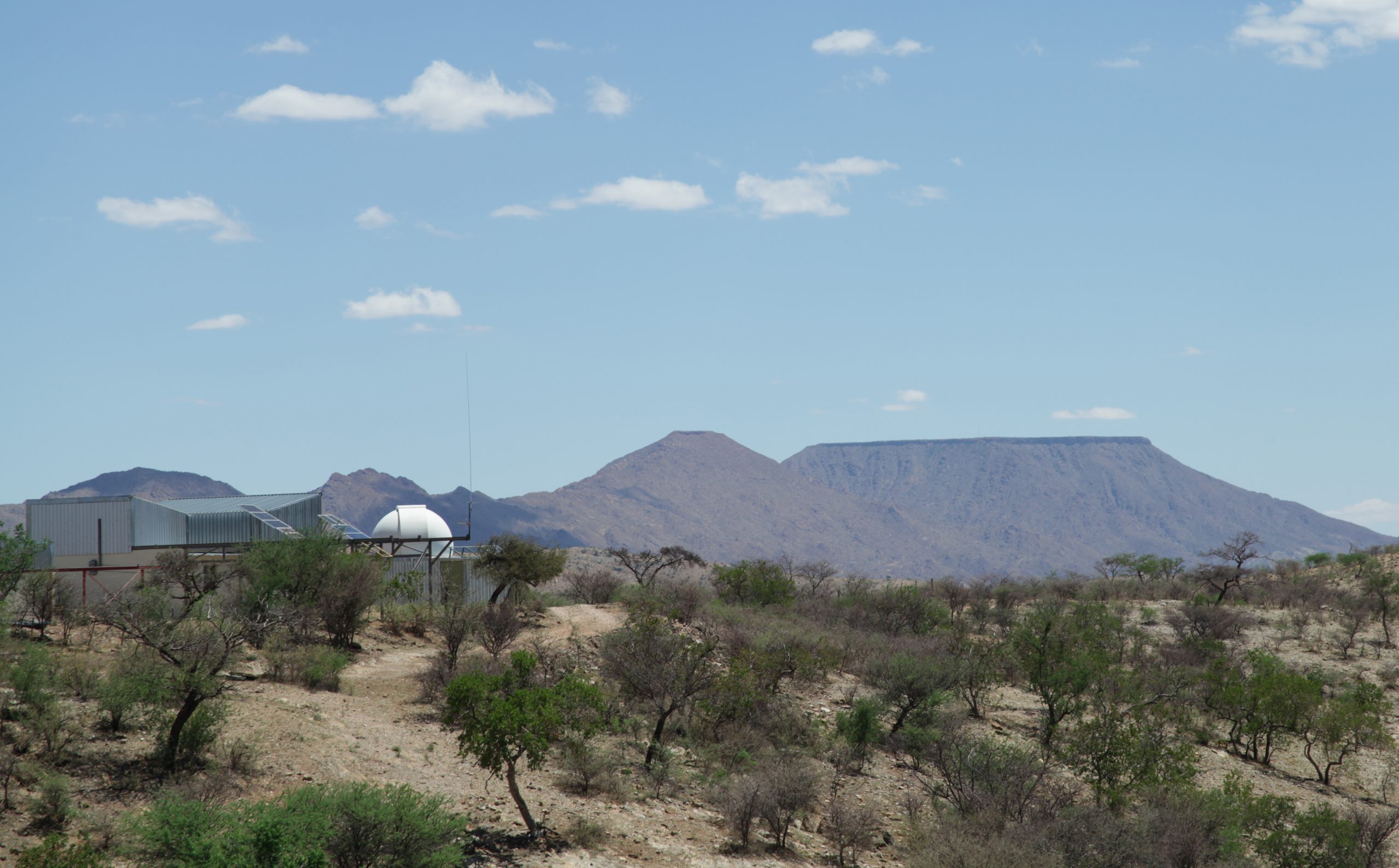
Hakos Farm
Namibia
Since 2009 I am a member of IAS with its astronomical site at Hakos Farm in Namibia. This gives me the opportunity to use several larger telescopes there. My favourite is a 20" Keller Cassegrain with imaging possibilities in the primary and secondary focus.
Contact me
.This is how you can reach me - for suggestions, comments or even criticism. I welcome any constructive dialogue, because learning never stops!

