

Dumbbell Nebula
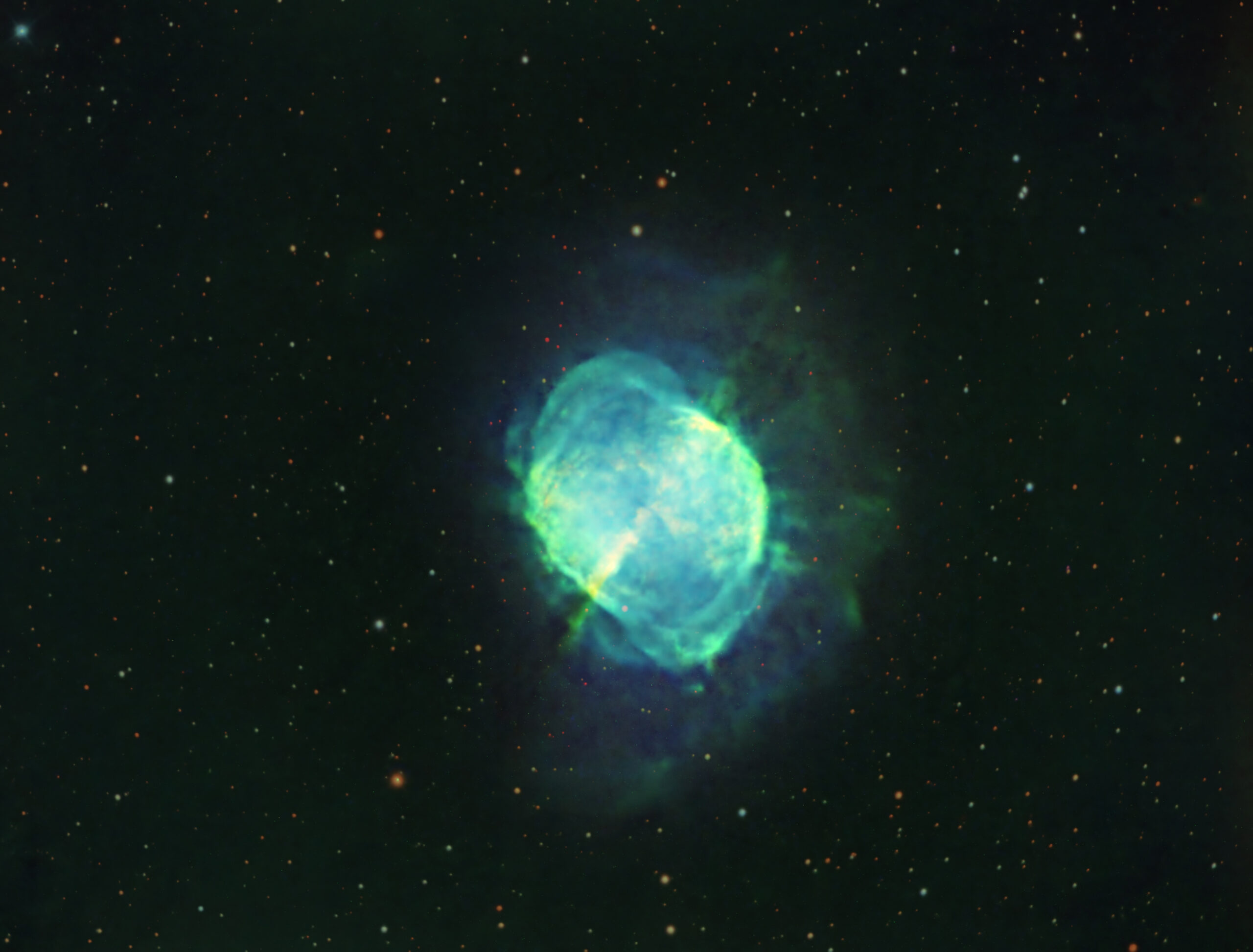
Dumbbell Nebula: This is one of the most pretty examples of a so-called Planetary Nebula. The old astronomers called this type of objects planetary because in their low-resolution telescopes they looked like planets. Today we know that these are dramatic events of dying stars, which expell lots of their matter when they start to expand into Red Giants.
This deep exposure shows, unlike normal ones, also the very weak outer regions of the nebula. The image was captured using Narrow-Band-Filters for the spectral lines of Hydrogen H-alpha, Oxygen [OIII] and Sulphur [SII]. They were combined according to the Hubble Palette.
Object |
Dumbbell Nebula |
|---|---|
Catagory |
Emission Line Images |
Designation |
M27 |
Constellation |
Vulpekula |
Optics |
RC 8" f/8, ZWO focuser, ZWO 7-Pos filterwheel |
Mount |
Sky-Watcher AZ-EQ6 Pro |
Camera |
ASI 1600MM Pro |
Exposure |
32x5m S2,25x5m H-alpha,35x5m O3,30x2mL,10x1m RGB each, ZWO Filterset. N.I.N.A for image acquisition and sequencing. |
|---|---|
Calibration |
Dark and Flat Frame |
Guiding |
ASI 120MM Mini with ZWO OAG, PHD2 as Guiding Software |
Processing |
PixInsight, Photoshop. Color code Red: S2, G:Ha, B:O3. RGB as overlay. |
Location-Date |
Eningen,Germany - Several Nights in June 2023 |
Remark |