
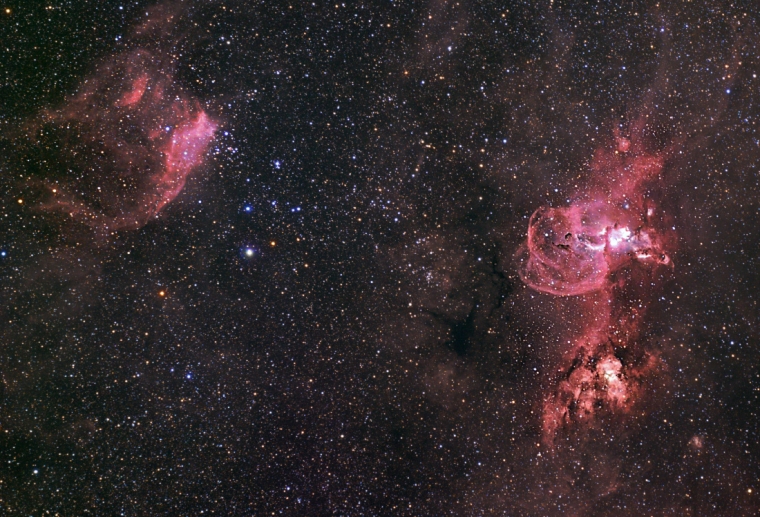
Galactic Nebulae NGC 3576 and NGC 3603

Galactic Nebulae NGC 3576 and NGC 3603: East of the splendid Eta Carinae Nebula lie several very interesting starbirth regions, not so often imaged.
On the left of this image one can see the Open Cluster NGC 3572 of young hot stars with a nice emission nebulosity around them. The two nebulae on the right hand side seem to be very close together, but this is an illusion.The upper one, NGC 3576, is in a distance of approx. 7000 light years whereas NGC 3603, the lower one, is 14000 light years away. One can recognize this by their different color:Due to the extinction by interstellar dust NGC 3603 has a more yellow tint.
Both nebulae are very active starbirth regions, which can be recognized by the generation of emission nebulae and shock fronts through their immense radiation and star winds all over the place. NGC 2603 is one of the most intense star nurseries known with giant white stars, so called Wolf-Rayet stars, at its center.
For a smaller field of view click the Hi-Res version, where especially the looping shock fronts of NGC 3576 can be studied.
Object |
Galactic Nebulae NGC 3576 and NGC 3603 |
|---|---|
Catagory |
Nebulae |
Designation |
NGC 3576, NGC 3603 |
Constellation |
Carina |
Optics |
TMB 130 f/6 with Field Flattener |
Camera |
SBIG STL 11000M with internal CFW 5 |
Exposure |
5 x 20min (1x1 bin) Baader H-alpha (7nm) filter, 3 x 10min each (1x1 bin) Astrodon True Balance RGB filterset. Maxim DL for image acquisition |
Calibration |
Dark Frame |
|---|---|
Guiding |
Selfguiding |
Mount |
Astro-Physics 900 GTO |
Processing |
Maxim DL5, Photoshop. Color Code L:Ha,RGB |
Location, Date |
Somerset West, South Africa - 24+28 March 2009 |
Remark |
Multiple Luminance Layering |

