
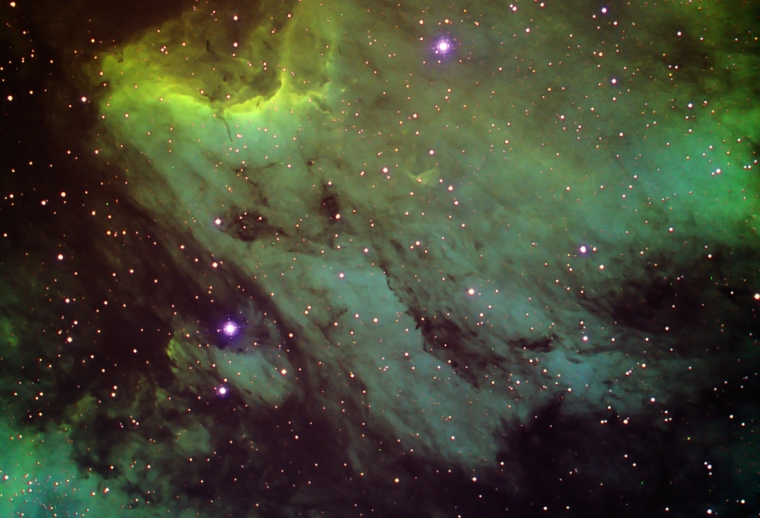
Pelican Nebula (false color image)
_R(S2100m)_G(Ha110m)_B(OIII110m)_final.jpg)
Pelican Nebula: Shaped like a Pelican this emission nebula is just next to the huge North America Nebula complex, but rather less bright. It is a classic star forming region where stars are born out of tremendous gas and dust clouds, thus creating also shock fronts (e.g. in the upper part of the image) by their strong star winds.
The image is a so called "false color image" (emission line image) using three different narrow spectral lines for imaging: Hydrogen H-alpha, Oxygen [OIII] and Sulfur [SII] representing Green, Blue and Red.
The imagen has been selected Astrofoto of the Week by Astronomie.de.
Object |
Pelican Nebula (false color image) |
|---|---|
Catagory |
Emission Line Images |
Designation |
IC 5070 |
Constellation |
Cygnus |
Optics |
Vixen R200SS 8 inch, f/4 with Baader Coma Corrector |
Camera |
OHY8/ALccd 6c |
Exposure |
11 x 10min Astronomik H-alpha filter,11 x 10min [OIII] filter, 4 x 15min [SII] filter, Maxim DL for Capturing |
Calibration |
Flat frame |
|---|---|
Guiding |
Meade DSI Pro II and TMB 80 as Guide Scope. Maxim DL as Guiding Software |
Mount |
Takahashi EM-11 |
Processing |
ImagesPlus, Photoshop. Maxim DL for color channel combination. Color Coding: L(H-alpha), R([SII]), G(H-alpha), B([OIII]) |
Location, Date |
Eningen, Germany - 7+13 +27 Aug 2008 |
Remark |


