

Helix Nebula
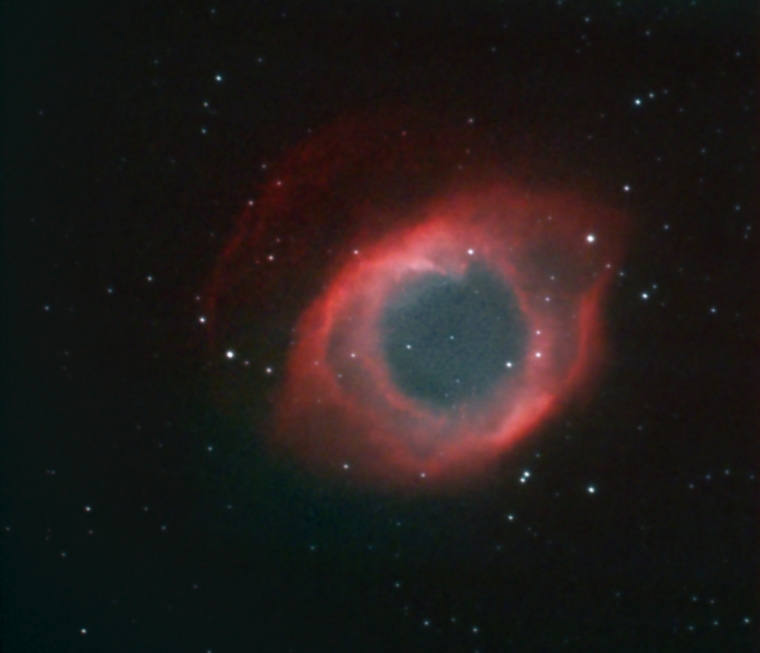
Helix Nebula: It is one of the most extended Planetary Nebula in the sky, but not so easy to observe, because of its low surface brightness. The star in the center is the dying sun that is the cause of the beautifully colored emission structure of the expelled gas hitting interstellar matter.In this combination image, using also 60 min of exposure with a narrow- band filter a very faint extension of the inner shells can be observed.
For a combined Hubbel and ESO image see here.
Object |
Helix Nebula |
|---|---|
Catagory |
Planetary Nebulae |
Designation |
NGC 7293 |
Constellation |
Aquarius |
Optics |
Meade LX 200 GPS 10 inch f/10 x 0.5 Giant Easy Guider |
Camera |
Hutech modif. Canon EOS 30D and QHY8/ALccd 6c |
Exposure |
20 x ISO 1600-1min IDAS LPS filter(EOS 30D),12 x 5m Astronomik Ha filter(QHY8/ALccd 6c) |
Calibration |
Dark Frame for EOS 30D |
|---|---|
Guiding |
Unguided for EOS 30D, TMB 80 as Guide Scope, Maxim DL as Guiding Software for QHY8/ALccd 6c |
Mount |
Equatorial Superwedge |
Processing |
ImagesPlus, Neat Image, Photoshop |
Location, Date |
Somerset West, South Africa - 29 Oct 2007 + 10 Nov 2007 |
Remark |
Color coding: L(Ha),R(Ha),G(LPS),B(LPS) |

