

Galactic Nebulae NGC 3576 and NGC 3603
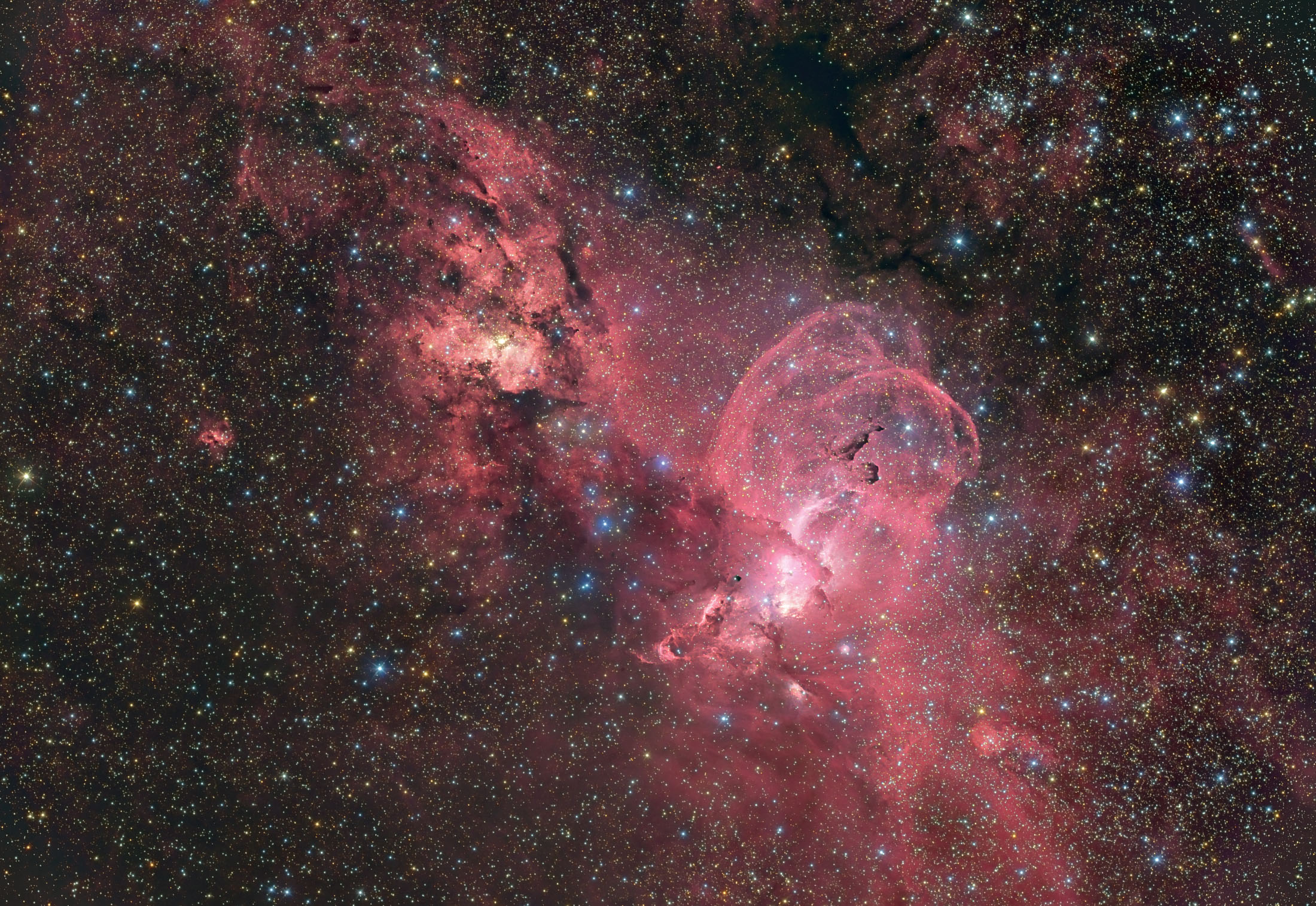
Galactic Nebulae NGC 3576 and NGC 3603: East of the splendid Eta Carinae Nebula lie several very interesting starbirth regions, not so often imaged. The two nebulae in this image seem to be very close together, but this is an illusion.The left one, NGC 3603, is in a distance of approx. 14000 light years whereas NGC 3576, the right one, is 7000 light years away. One can recognize this by their different color:Due to the extinction by interstellar dust NGC 3603 has a more yellow tint.
Both nebulae are very active starbirth regions, which is evident by the generation of emission nebulae and shock fronts through their immense radiation and star winds all over the place. NGC 2603 is one of the most intense star nurseries known with giant white stars, so called Wolf-Rayet stars, at its center.
In the Hi-Res version of the image this can be studied in detail.
The image was taken at the observatory of IAS at Hakos Farm in Namibia.
Object |
Galactic Nebulae NGC 3576 and NGC 3603 |
|---|---|
Catagory |
IAS Hakos, Namibia |
Designation |
NGC 3576, NGC 3603 |
Constellation |
Carina |
Optics |
Keller 20 inch Cassegrain f/3 in corrected primary focus |
Camera |
SBIG STL-11000M with internal CFW 5 |
Exposure |
3 x 10min Baader H-alpha filter, 3 x 5min each Baader RGB filterset. Maxim DL for image acquisition |
Calibration |
Dark Frame |
|---|---|
Guiding |
StarlightXpress Lodestar on Schneider OAG, Maxim DL as Guiding Software |
Mount |
Liebscher GEM |
Processing |
Maxim DL5, CCDStack, Photoshop. Color Code L:H-alpha, R/H-alpha,GB |
Location, Date |
IAS-Hakos, Namibia - 31 Mar 2011 |
Remark |

